How to Choose the Right Curtains for Bay Windows in Period Homes
Bay windows are the reason many of us fall for Victorian and Edwardian houses. They pull light into the middle of a room, make a narrow front parlour feel generous, and give a street-facing window somewhere to sit. They are also the reason plenty of people give up and hang a pair of ready-mades straight across the front, which rarely does the room any favours. Awkward angles, uneven ceilings and a radiator in the wrong place are all manageable. The trick is to settle the fitting and the measurements before you spend anything on fabric.
Start with the shape of the bay
Spend ten minutes working out what you are actually dealing with, because bays vary enormously, even between neighbouring houses on the same terrace.
- Victorian bays are often three or five-sided, with tall sash windows and deep reveals. Some are shallow bows that barely project from the wall.
- Edwardian bays tend to be wider and shallower, usually three-sided with a flat central face and angled returns.
- Look up and around. Cornicing, picture rails and dado rails all affect where a track can sit and how high it can go.
- Find the radiator. If there is one under the sill, it changes the whole plan.
- Check the ceiling line. Old ceilings sag. A track fixed to a wavy line will look wavy.
Choose where the curtains will run
There are only two real options, and the choice decides everything else.
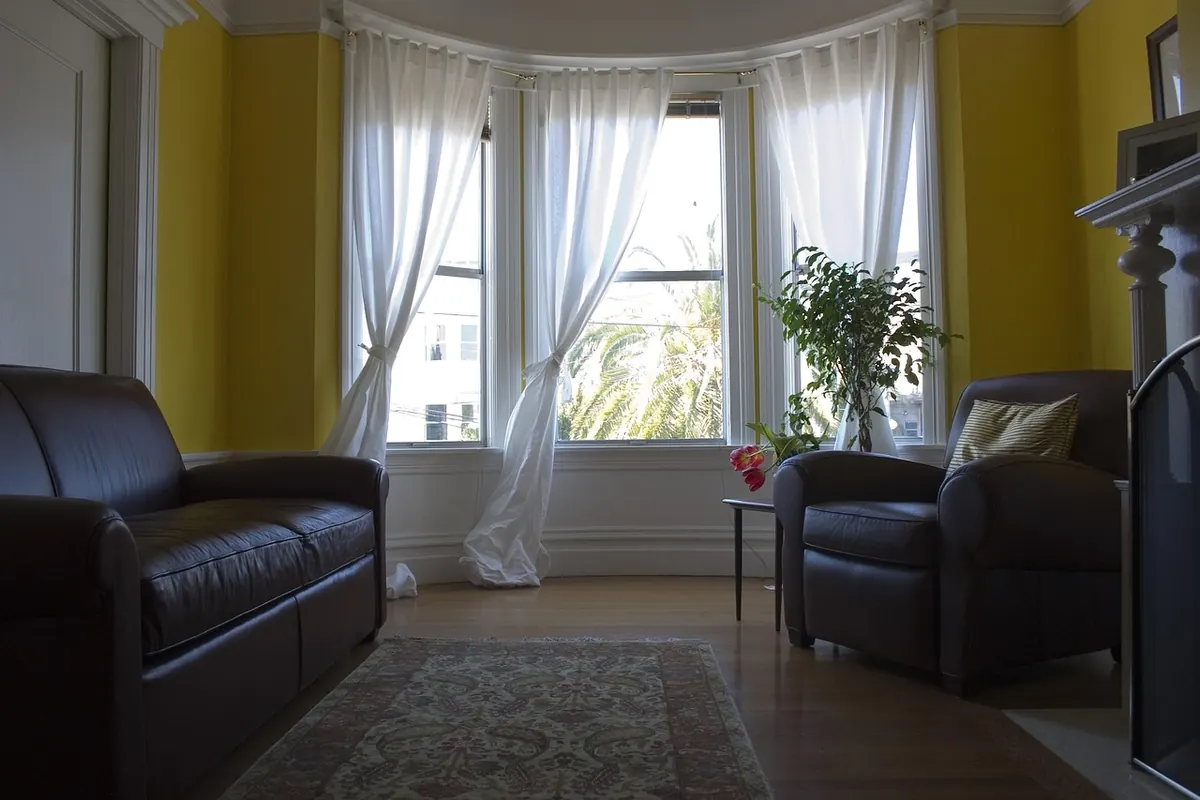
Inside the bay. The track follows the angles of the bay itself, so each curtain panel sits inside the window reveal. This uses far less fabric, keeps the shape of the bay visible, and looks disciplined in a smaller room. The trade-off is that the curtains cover less glass when drawn back, so you lose some privacy and draught control. And if there is a radiator beneath the sill, fabric hanging over it will send heat straight up behind the curtains instead of into the room.
Across the front of the bay. The track runs along the ceiling or wall, either straight across the opening or following the bay line and returning to the walls. This is the more generous, more theatrical look, and it gives you proper overlap in the middle. It also costs considerably more in fabric, and it hides the very feature you fell for.
Measuring a bay, step by step
Work in centimetres, write everything down, and measure twice at different points along the same line.
- Decide inside or outside the bay first. Measuring before you have made this decision wastes an afternoon.
- For an outside fitting, measure the full width from wall to wall across the widest point of the opening, plus an allowance of roughly 10–15cm at each end so the curtains can be drawn clear of the glass.
- For an inside fitting, measure each face separately, angle to angle. Do not assume the sections are equal — they usually are not.
- Measure the drop from the exact line where the track or pole will be fixed, not from the top of the window. Then measure again at the left, centre and right, and work to the shortest figure.
- Check obstacles: radiator tops, protruding sills, window handles, sockets, the swing of a door.
- Note the depth of the reveal. Under about 8cm, a track fitted inside the bay will leave fabric brushing the glass, which is bad for condensation and worse for the fabric.
Tracks, poles and the problem of angles
Most bay window failures are fitting failures, not fabric failures. Get this part right and the rest is straightforward.
- Bendable or made-to-measure track, fixed to the ceiling on a timber batten, is the most reliable solution. It follows the angles tightly and keeps the whole window clear.
- Bay pole kits with corner joints work well for a traditional look, but eyelet curtains will not travel round a corner. Use pencil pleat or pinch pleat if you want to draw them.
- Recess brackets are neat and inexpensive, and they hold curtains close to the glass. They suit sash windows well, but they limit how far back the curtains will stack.
- Corded or uncorded? A cord makes a wide bay far easier to manage day to day. In a five-sided bay it is close to essential.
Whatever you choose, fix the track to a solid timber batten rather than straight into old plaster. Plaster over brick or lath will not hold a heavy curtain for long.
Fabric, lining and fullness
Bays are exposed on three sides, which means more glass, more draught and more street noise. Mid-weight fabrics — wool, velvet, linen union, heavy cotton — hold a pleat properly, hang well and do more of that work for you. Lightweight silks and voiles are lovely in a bay, but they are better layered over a blind or shutters than asked to perform on their own.
How much fabric
As a rule of thumb, pencil pleat needs roughly two to two and a half times the track width in fabric; pinch pleat and goblet pleat about two times. A wide bay in a busy pattern can swallow many metres once the pattern repeat is matched across panels, so a small-scale motif, a stripe or a plain with a contrasting trim often gives more for the money.
Linings and interlining
Standard lining protects the face fabric from sunlight. Blackout lining earns its place in bedrooms. Bump interlining adds body, softens the light and takes the edge off draughts from old sashes — particularly worth it on north-facing bays, where the room will feel cooler anyway.
Style that suits a period room
In a Victorian room, deep colours and heavier textures sit naturally: berry reds, deep greens, inky blues, floral or damask patterns in a traditional scale. Curtains hung from the ceiling line down to the floor, or just breaking at it, keep the proportions generous. Avoid stacking the fabric so tightly that the bay disappears.
Edwardian rooms are lighter and more open. Plain linens, subtle stripes, soft greys and pale greens work well, often with a pelmet or a simple fabric-covered valance to tidy the track. Shutters or a Roman blind inside the bay, with curtains across the front, is a combination that suits these houses particularly well and gives you flexible control over light and privacy.
Do the track first, then buy the fabric
Order swatches before you commit, look at them in the room at different times of day, and hang the lining fabric against the glass to judge how much light it kills. Fit the track or pole, then measure the drop from the fixed line to your chosen finish. Curtains made to a measured track will always beat curtains made to an estimate, and a bay window is the one place where a few centimetres either way is visible every single day.
Photo: jmorton20090 / Pixabay

DIY Christmas Table Centrepiece Ideas Using Foraged Greenery
Gather ivy, holly, conifer and moss on a winter walk, then turn them into a low candle ring, a leafy...

A Checklist for Buying Second-Hand Furniture Online in the UK
What to measure, ask and inspect before buying pre-loved furniture online — plus the red flags that mean...
About Us